BFCM planning used to divide pretty neatly. Infrastructure teams worried about uptime, scaling and checkout performance. Ecommerce teams focused on merchandising, conversion and campaign execution. Agencies helped connect the work, but the technology decisions themselves often stayed in separate lanes.
Now merchants are asking agencies to solve those problems together. Adobe reported AI-referred retail traffic surged 693% year over year during BFCM 2025. That traffic does not behave like organic search. It arrives with intent, with context, and with expectations set by an AI assistant that already answered half the shopper’s questions before they landed. Agencies that treat that traffic the same way they treated 2024’s are going to lose the merchant conversation this year.
Webscale has spent the last decade running commerce infrastructure for brands like Jaguar Land Rover, Unilever and Dollar General. That is the platform the Agentic Commerce OS is built on. Commerce AI you can trust, because the data underneath it is real.
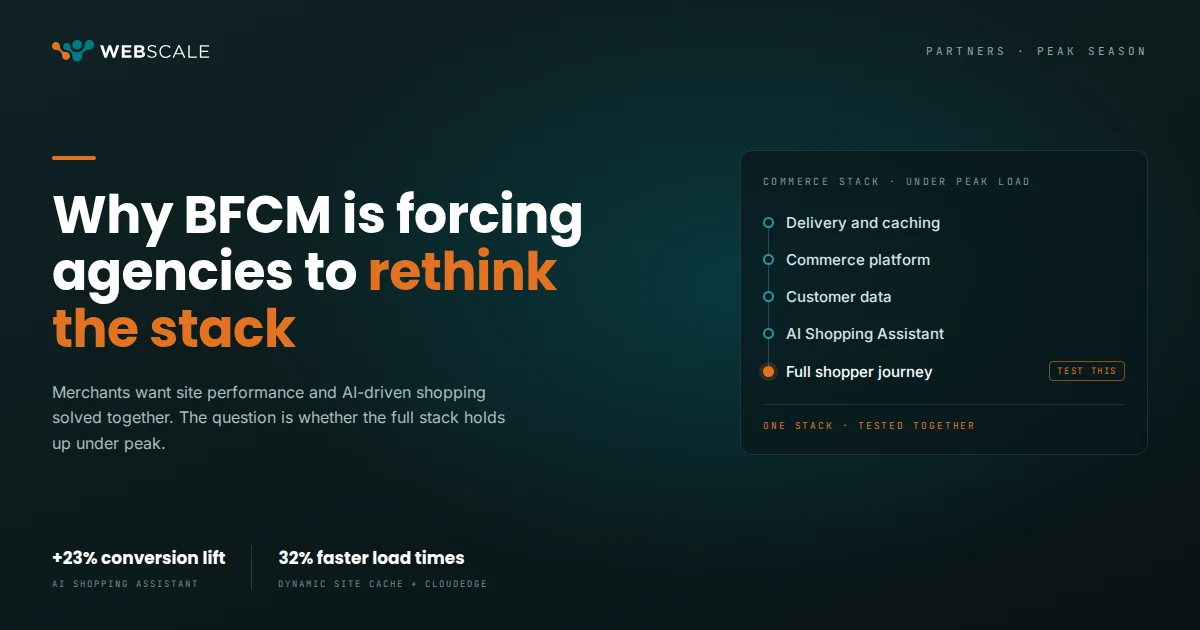
Peak readiness now crosses more of the stack
A merchant preparing for BFCM may begin with infrastructure: load testing, caching, edge delivery, security and checkout resilience. Those remain foundational because a slow or unavailable storefront will erase the value of everything built on top of it.
But once the site can handle the traffic, the next question is what happens to that traffic.
Can shoppers find the right product quickly? Can they compare options? Can the storefront respond when a search fails or a shopper gets stuck? Can an AI Shopping Assistant work from current product and policy data instead of incomplete or stale information?
These are conversion questions, but they are also architecture questions.
The experience a shopper sees on the storefront depends on what is happening underneath it. Product discovery depends on catalog quality. Personalization depends on shopper data. AI responses depend on the systems and rules they can access. Performance still depends on the delivery layer supporting all of it.
BFCM readiness has stopped being a collection of unrelated point solutions.
Integration problems get harder to diagnose under peak traffic
A commerce stack can look healthy under normal conditions while still carrying hidden dependencies.
The CDN works. The commerce platform works. The CDP works. The analytics tools work. The AI application works. Then traffic spikes.
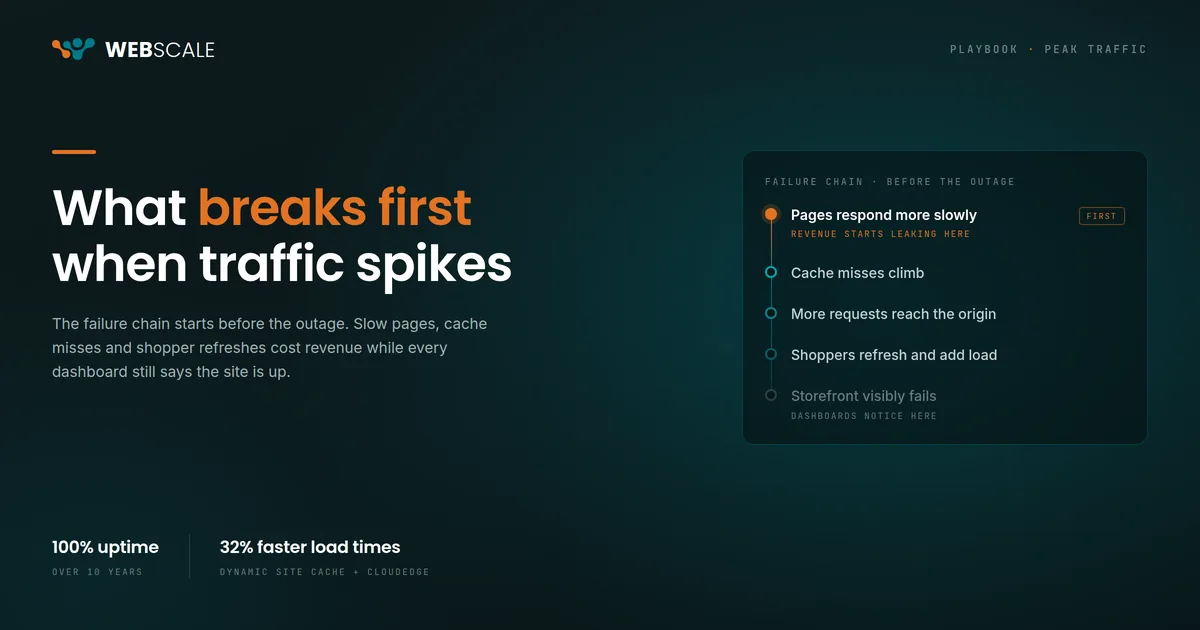
If response times start climbing, it becomes harder to understand which system is creating the problem. A cache issue can increase origin load. A third-party service can slow down the shopper journey. A data dependency can delay an AI response. One small problem can create pressure somewhere else in the stack.
When those systems come from several vendors, the agency is often the one expected to help the merchant figure out what happened. Agencies should know where critical commerce data comes from, how quickly it moves between systems, what happens when one dependency becomes slow or unavailable and who owns the response when something fails.
Those answers are much easier to get during planning than during a live BFCM incident.
The data problem the category is ignoring
AI Shopping Assistants and other commerce AI applications add another layer to the storefront, but the quality of the experience depends heavily on what sits behind them.
The first question an agency should ask is what information the application can access.
A useful shopping assistant needs current catalog data, product attributes, availability where relevant, merchant policies and clear business rules. It also needs enough session context to understand what the shopper has already asked or viewed. If that information lives across disconnected systems, the agency needs to understand how those connections work and what happens when information conflicts.
Which source is authoritative for inventory? How quickly do product changes become available to the assistant? Can the merchant control what the assistant is allowed to recommend or say? What happens when the assistant does not have enough information to answer confidently?
Those questions determine whether the application remains useful once it leaves the demo environment and starts serving real shoppers. This is where most of the category falls apart. An AI wrapper sitting on top of a commerce stack it cannot see will hallucinate a return policy under load, quote an expired promotion, recommend a discontinued SKU. The category treats hallucination as cost. We treat it as defect. That difference shows up hardest during BFCM, when the assistant is fielding thousands of questions a minute and there is no human in the loop to catch a bad answer.
Test the shopper journey, not just the technology
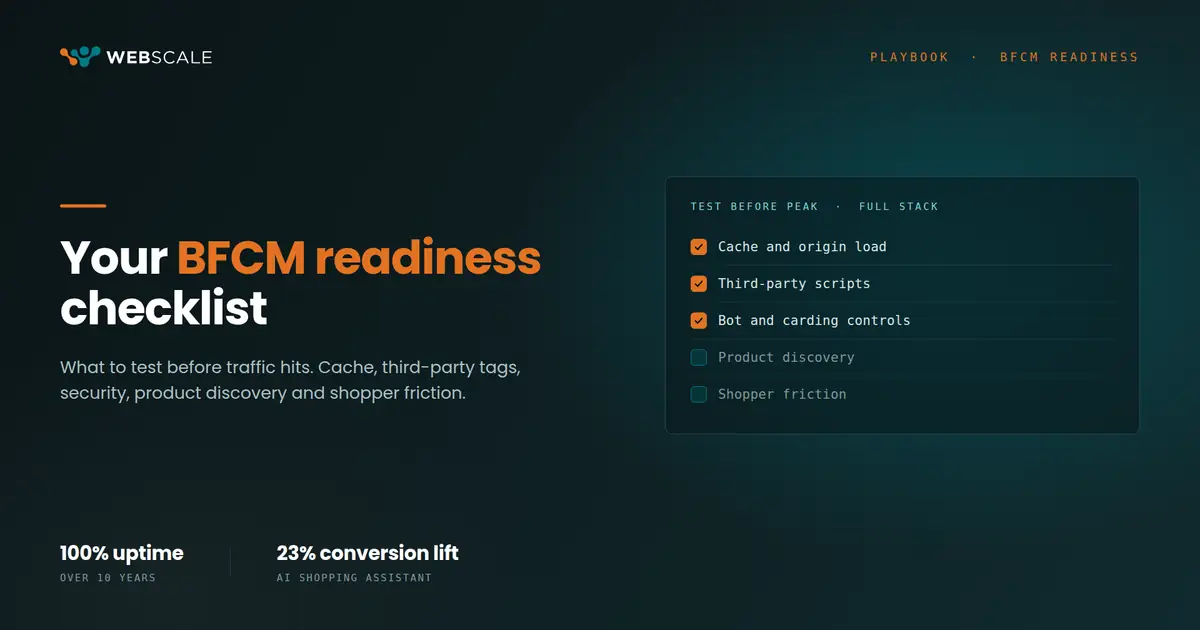
Traditional BFCM testing often focuses on infrastructure metrics. Agencies should expand that test to cover the full shopper path.
Start with the expected peak traffic, but do not stop there. Test how the storefront behaves when traffic exceeds the forecast. Watch page performance, checkout responsiveness and third-party dependencies together.
Then test product discovery. Use the language real shoppers use instead of exact catalog terminology. Test comparisons, alternatives, compatibility and unavailable products. Confirm that product recommendations reflect current information.
If the merchant is using an AI Shopping Assistant, look at what happens after the conversation. Does the shopper reach a relevant product page? Do they add an item to cart? Does the assistant keep useful context as the conversation changes?
Session friction belongs in the same test. A site can remain technically available while shoppers struggle with failed searches, slow pages or dead ends in the journey. The closer the test gets to the experience of a real shopper, the more useful it becomes.
Consolidation reduces the number of places things can fail
For agencies, one of the most important BFCM considerations is how much coordination the stack requires. Every integration creates another dependency to understand, monitor and support. During normal operations that may be manageable. During peak traffic, the operational cost becomes obvious.
Webscale has built the Agentic Commerce OS alongside its application delivery infrastructure for exactly this reason. The Customer Data Platform, AI Segmentation and AI Shopping Assistant operate from the same commerce foundation that supports storefront performance and delivery. For partners, that means fewer places where context, data and responsibility can become disconnected.
Famous Smoke Shop consolidated onto one platform with Webscale. Email revenue lifted 31% in the first quarter. Jaguar Land Rover saw a 23% conversion lift on Webscale in Q3 2024. Those are single-merchant, first-order outcomes, not category averages. They matter in a BFCM conversation because they connect shopper experience and site performance instead of treating them as separate problems.
What agencies should ask before BFCM
Before peak season, agencies should be able to answer these questions for every merchant they support:
- Where does storefront performance begin to degrade under load?
- Which third-party services are part of the critical shopping path?
- What systems provide product, inventory and shopper data to AI applications?
- Which source is authoritative when information conflicts?
- Can the merchant control the rules the AI follows?
- How is shopper friction identified while the session is still active?
- Who owns each part of the response when something fails?
- Can the full shopper journey be tested under peak conditions before November?
Answering these on gut feel is one thing. Scoring them formally is another. The Agentic Commerce Alliance launches the Agentic Commerce Maturity Index on September 29, a 25-minute assessment that scores merchant readiness across discovery, transactions, fulfillment and operations. Webscale is an Alliance partner. It is a useful diagnostic to run with a merchant before the BFCM conversation gets into vendor selection.
These are not purely infrastructure questions or AI questions. They are commerce questions.
The partner opportunity is broader than BFCM
BFCM creates urgency, but the underlying shift is larger. Merchants are asking agencies to connect infrastructure, data and AI into one working commerce experience. The agencies that understand those layers together will be better positioned to guide technology decisions well beyond peak season.
Webscale built the Relay AI Partner Program for agencies and technology partners working across both sides of the commerce stack. Partners bring the merchant relationship and implementation expertise. Webscale supports the infrastructure and AI layers behind the experience.
Same orchestrator. Same agents. Same trust profile.