If the Webscale Data Plane is the heart of your application then the Webscale Control Plane is the brain. Webscale’s distributed control plane is decoupled from the data plane, and together they allow Webscale to provide the security and performance modern web applications require.
Much like the data plane, 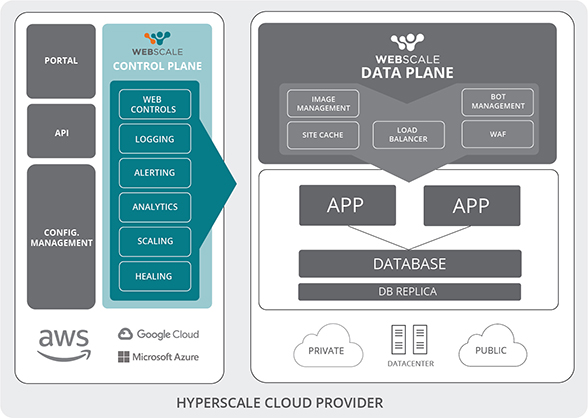 the control plane is made up of multiple cloud servers, but it is also decoupled from the data plane to remove the single point of failure that can so often be the Achilles’ heel of any application. This decoupling also frees up the data plane so that it can continue to serve your application to your end-users without interference from the processing that the control plane carries out.
All of the features of the Webscale Data Plane rely on the control plane’s decisions to work. The traffic and load going through the data plane are monitored and interpreted by the control plane, which then sends the proper commands to the data plane so it can perform the various tasks we talked about in the data plane article to speed up and protect your applications.
What this means is that the control plane can predictively scale-out or scale-in new application servers and self-heal the application or quarantine any infected servers. The control plane is also where your Web Controls are managed. When the data plane receives traffic or requests that match your Web Control settings, the control plane makes decisions based on your web controls and sends the appropriate response to the data plane.
Together with the data plane, the control plane is an integral part of the Webscale infrastructure and improves the performance, security, reliability, and scalability of your application. Working in concert, these powerful features help ensure your peace of mind since you can rest easy knowing your application is achieving its peak performance.